
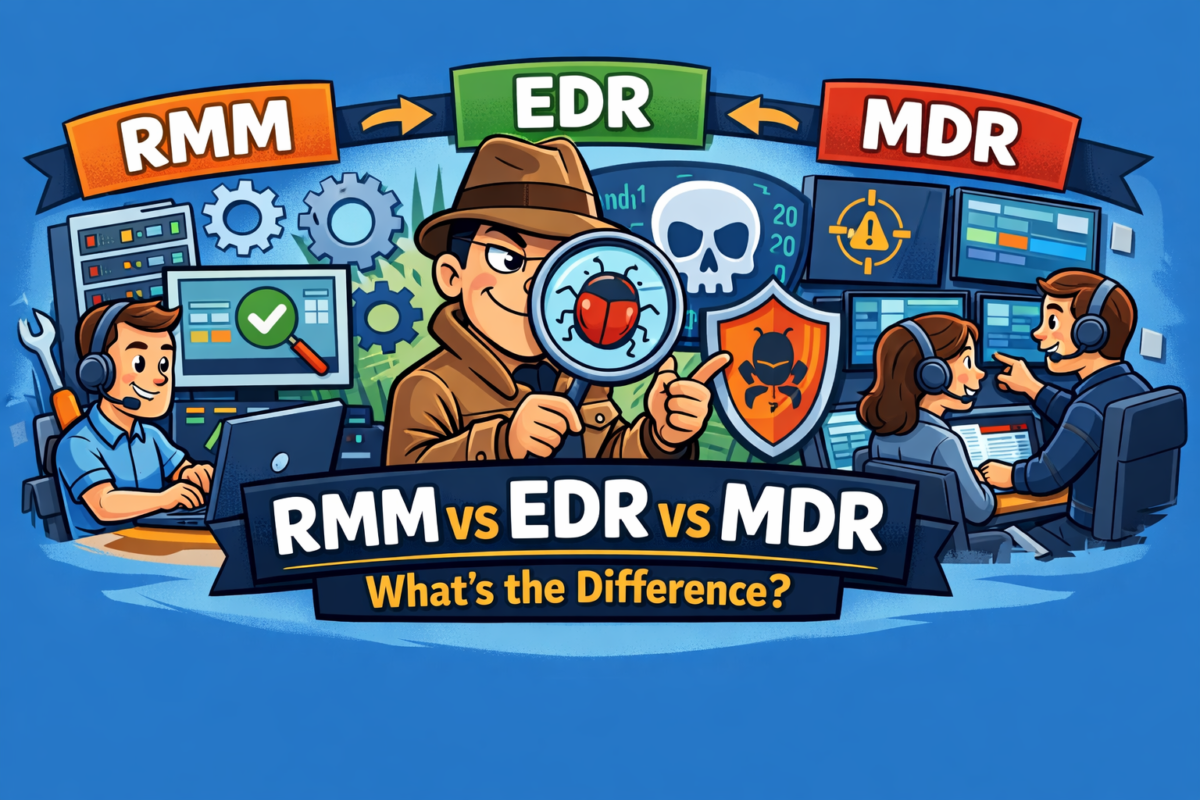
RMM vs EDR vs MDR: What’s the Difference?
Security conversations get crowded fast.
RMM, EDR, MDR—three acronyms that sound similar, often get grouped together, and are frequently misunderstood. The result? Businesses think they’re protected when they’re only covering part of the picture.
Let’s break it down properly.
What is it?
At a high level, these are three different layers of IT management and security—each solving a different problem.
RMM (Remote Monitoring & Management)
RMM is your operational backbone.
It gives IT teams visibility into devices, systems, and performance across your environment. It’s how updates get pushed, systems get monitored, and routine issues get fixed—often before users notice.
What it does:
- Patch management (Windows, third-party apps)
- Remote access and support
- System monitoring and alerts
- Scripted automation (restarts, cleanups, deployments)
👉 Think of RMM as keeping the lights on and everything running smoothly.
EDR (Endpoint Detection & Response)
EDR is your security layer at the device level.
It continuously monitors endpoints (laptops, servers) for suspicious behavior—not just known threats, but unusual patterns that could signal an attack.
What it does:
- Detects ransomware, malware, and suspicious activity
- Tracks behavior (not just signatures)
- Isolates infected devices
- Provides forensic visibility into incidents
👉 Think of EDR as watching for threats inside your systems.
MDR (Managed Detection & Response)
MDR is the human + expertise layer on top of EDR.
It takes the data from EDR and adds a team of security analysts who actively monitor, investigate, and respond to threats in real time.
What it does:
- 24/7 threat monitoring
- Threat hunting and investigation
- Incident response and containment
- Escalation and guidance
👉 Think of MDR as having a security team actively defending your business.
Why should you care?
Because having one without the others creates gaps.
- RMM keeps systems updated—but it won’t stop a sophisticated attack
- EDR detects threats—but it doesn’t always respond fast enough on its own
- MDR responds to threats—but relies on strong tools underneath
Most breaches don’t happen because nothing was in place. They happen because:
- Tools weren’t integrated
- Alerts weren’t acted on
- Responsibility wasn’t clearly defined
And that’s where risk builds quietly.
A business running only RMM may feel “managed,” but not secure.
A business running EDR without oversight may be alerted—but not protected.
Real protection comes from layering these properly and making them work together.
What can you do?
Start by looking at your current setup honestly.
- Are your systems being patched and monitored consistently? (RMM)
- Do you have real visibility into endpoint threats? (EDR)
- Is someone actively watching and responding to alerts 24/7? (MDR)
If any of those answers are unclear, there’s a gap.
The goal isn’t more tools. It’s a connected system where operations and security support each other—not operate in silos.
Britec helps
Technology shouldn’t feel like layers of disconnected tools. It should feel coordinated, predictable, and under control.
At Britec, we bring together RMM, EDR, and MDR into a single, managed approach—so your systems are maintained, your threats are monitored, and your business is protected without the guesswork.
Britec helps you stay ahead with smart IT and secure solutions.