
Ransomware Is Scaling Faster Than Your Defences
Ransomware isn’t just growing—it’s accelerating.
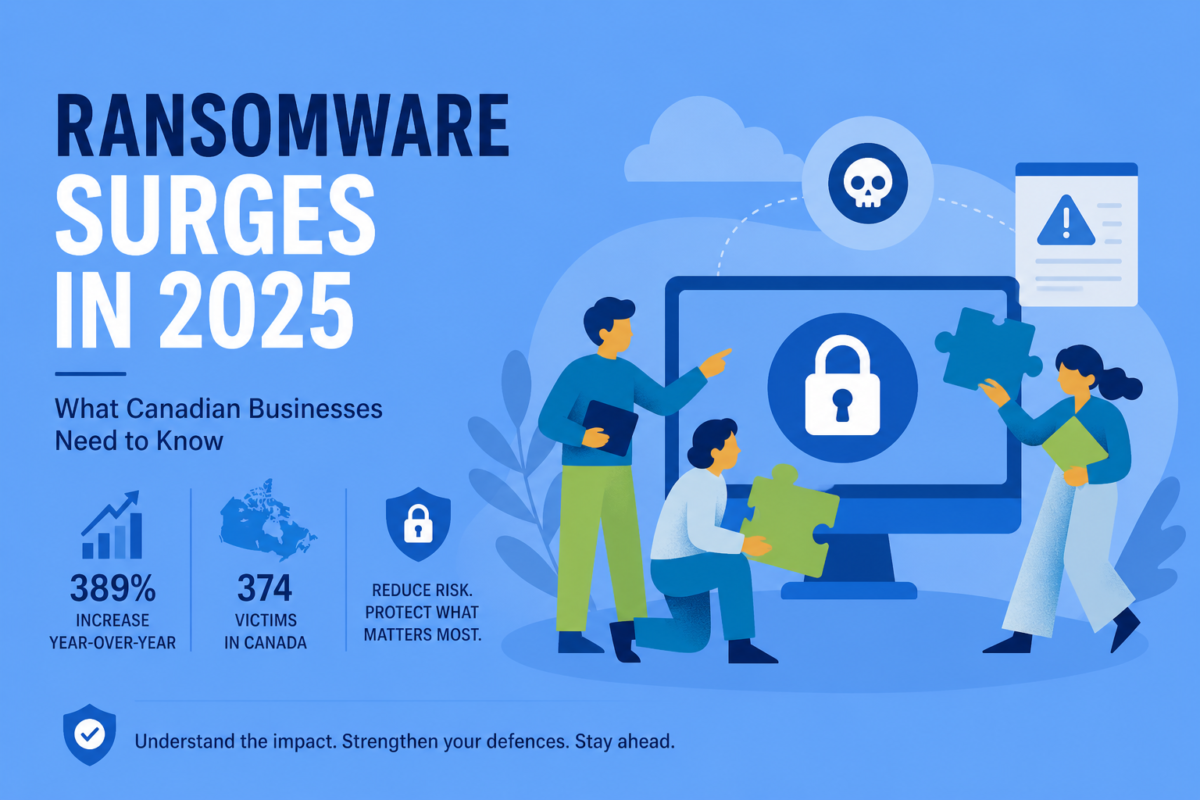
Recent data shows over 7,800 confirmed ransomware victims in 2025, up from roughly 1,600 the year before—a 389% year-over-year increase. Canada alone accounted for hundreds of cases, placing it firmly on the radar for targeted attacks.
This isn’t random. It’s becoming a system.
Ransomware facts that reveal the current state of affairs:
- 374 ransomware victims reported in Canada (2025)
- United States recorded 3,381 victims; Germany 291
- Top targeted industries:
- Manufacturing: 1,284 victims
- Business services: 824
- Retail: 682
- Time-to-exploit has dropped to 24–48 hours
- Some attacks begin within hours of vulnerability disclosure
- AI-driven tools contributing to attacks:
- WormGPT
- FraudGPT
- BruteForceAI
- Most cloud breaches are caused by stolen or misused credentials
- Phishing and credential compromise remain top entry points
- Over 5,600 ransomware attacks were publicly disclosed in 2024
- Ransomware costs increased ~74% year-over-year (recent trend)
- Double extortion tactics (encryption + data leak threats) are now common
What is it?
Ransomware has evolved from isolated attacks into a structured, scalable business model.
With the rise of AI-driven tools like WormGPT and other “crime-as-a-service” kits, attackers no longer need deep technical skills. They can:
- Launch attacks faster
- Target more businesses at once
- Refine tactics using automation
The result: more attacks, more often, with higher success rates.
Why should you care?
For leadership teams, this is no longer an IT issue—it’s an operational and financial risk.
The most targeted industries—manufacturing, business services, and retail—aren’t chosen by accident. They’re chosen because downtime is expensive.
A ransomware event can mean:
- Operations halted for hours or days
- Revenue loss during outages
- Recovery costs that exceed the ransom itself
- Reputational damage that lingers beyond the incident
And here’s the shift: attackers are betting that paying the ransom is cheaper than the disruption.
In many cases, they’re right.
What can you do?
You don’t need to outsmart ransomware—you need to reduce your exposure and improve your response.
Start with:
- Understanding where your business is most vulnerable
- Identifying gaps in backup, recovery, and access controls
- Ensuring your team can respond quickly—not reactively
This is less about adding more tools and more about making sure what you have actually works together.
Ransomware isn’t slowing down—but your risk can be managed.
Get a clear view of where your business is exposed, what a disruption could cost, and how quickly you could recover.
At Britec, we help organizations turn uncertainty into clarity—with practical, tailored security assessments built around your business.
Reach out to Britec for a consultation today.