
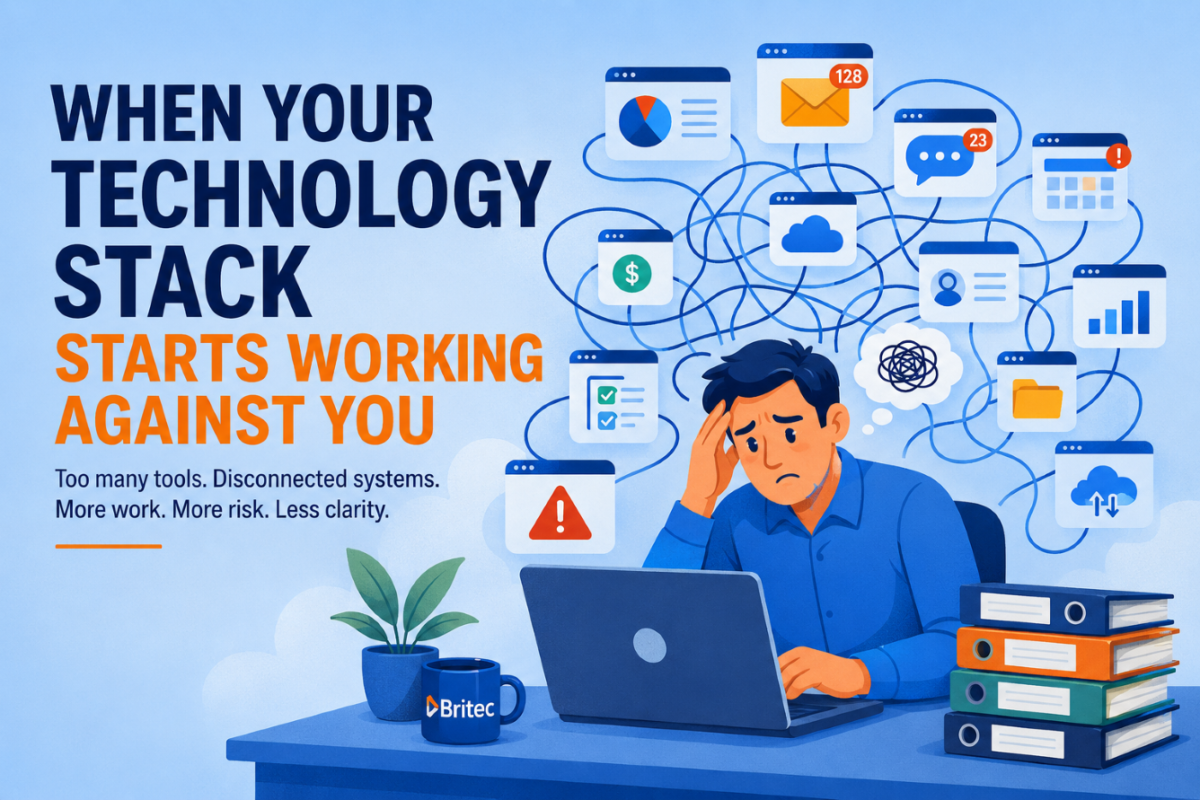
When Your Technology Stack Starts Working Against You
Technology is supposed to make business easier. Faster workflows. Better visibility. More collaboration. Stronger security.
But over time, many businesses slowly build a collection of tools that were added to solve one problem at a time without an overall strategy connecting them together.
A new platform gets added for communication. Another for project tracking. Another for security. Another for reporting. Before long, teams are jumping between systems, duplicating work, and creating manual processes just to keep operations moving.
The problem isn’t always the tools themselves.
It’s what happens when too many disconnected systems begin working against each other instead of supporting the business as a whole.
Have a quick look at stats related to your Stack holding you back.
- Businesses lose up to 30% of productivity to inefficient workflows and disconnected systems
- Employees switch between apps and tools more than 1,000 times per day on average
- The average company now manages 100+ software applications
- Operational complexity increases cybersecurity risk, human error, and downtime
- Integrated systems can reduce operational costs by up to 25%
The Signs Usually Start Small
At first, the issues don’t feel serious.
Maybe employees export spreadsheets because systems don’t sync properly. Maybe approvals slow down because information lives in multiple places. Maybe teams use overlapping software without realizing it.
Over time, these small inefficiencies become operational drag.
Businesses often experience:
- Duplicate software and overlapping costs
- Manual data entry between platforms
- Increased onboarding complexity for staff
- Delayed reporting and decision-making
- Alert fatigue from too many disconnected systems
- Security gaps between tools that aren’t fully integrated
- Features being paid for but rarely used
Eventually, technology starts creating more work instead of removing it.
Complexity Creates Risk
One of the biggest misconceptions businesses face is believing that more technology automatically means better protection or better efficiency.
Truthfully, unmanaged complexity often creates the opposite effect.
When systems don’t communicate properly, visibility decreases. Teams rely on workarounds. Processes become inconsistent. Security policies become harder to enforce.
Even basic tasks like employee onboarding and offboarding become more difficult when access is spread across too many platforms.
The result is a business environment that becomes harder to manage, harder to secure, and more expensive to operate.
The Goal Isn’t More Tools
The goal should never be adding technology for the sake of it.
The goal is building systems that:
- work together,
- reduce friction,
- improve visibility,
- strengthen security,
- and support long-term growth.
Sometimes that means consolidating platforms. Sometimes it means improving integrations. Sometimes it means reviewing whether existing tools are even being fully utilized.
In many cases, businesses already own the technology they need. They just aren’t using it in the most effective way.
Technology Should Support Growth — Not Slow It Down
As businesses grow, complexity naturally increases. But unmanaged complexity quietly drains time, money, and productivity across the organization.
What feels manageable day-to-day can slowly become one of the biggest operational barriers inside a business.
That’s why regular technology reviews matter. Not just to identify security risks, but to uncover inefficiencies, overlap, and opportunities to simplify operations.
At Britec, we help businesses evaluate the systems they rely on every day and identify where technology may be creating unnecessary friction. The goal isn’t adding more complexity. It’s building technology environments that are secure, efficient, and aligned with how your business actually works.
FAQ
What is a technology stack?
A technology stack is the collection of software, platforms, tools, and systems your business uses to operate day-to-day. This can include communication tools, cybersecurity platforms, accounting software, cloud services, ERP systems, backups, and productivity applications.
How do I know if my technology stack is becoming too complex?
Common warning signs include duplicate software, manual workarounds, disconnected systems, slow reporting, excessive notifications, inconsistent processes, and employees regularly switching between multiple platforms to complete simple tasks.
Can too many tools create cybersecurity risks?
Yes. The more disconnected systems a business manages, the harder it becomes to maintain visibility, enforce security policies, manage permissions, and monitor for threats consistently. Complexity often increases the risk of human error and overlooked vulnerabilities.
Why do businesses end up with disconnected systems?
Most businesses add technology gradually over time to solve immediate problems. Without long-term planning or integration strategy, tools can accumulate quickly and create overlap, inefficiencies, and operational friction.
Does having more software improve productivity?
Not always. Technology should simplify operations, not create additional layers of complexity. Businesses often see better results from properly integrated systems than from adding more standalone tools.
How often should businesses review their technology stack?
Businesses should review their technology environment regularly, especially during periods of growth, operational change, cybersecurity planning, or budgeting cycles. Annual or semi-annual reviews can help identify inefficiencies and opportunities for improvement.
What are the benefits of consolidating systems?
Consolidating systems can improve efficiency, reduce costs, strengthen security visibility, simplify employee onboarding, reduce manual work, and improve overall business operations.
How can Britec help?
At Britec, we help businesses evaluate their current technology environments, identify operational inefficiencies, improve system integration, and align technology with long-term business goals. Reach out to us today!