
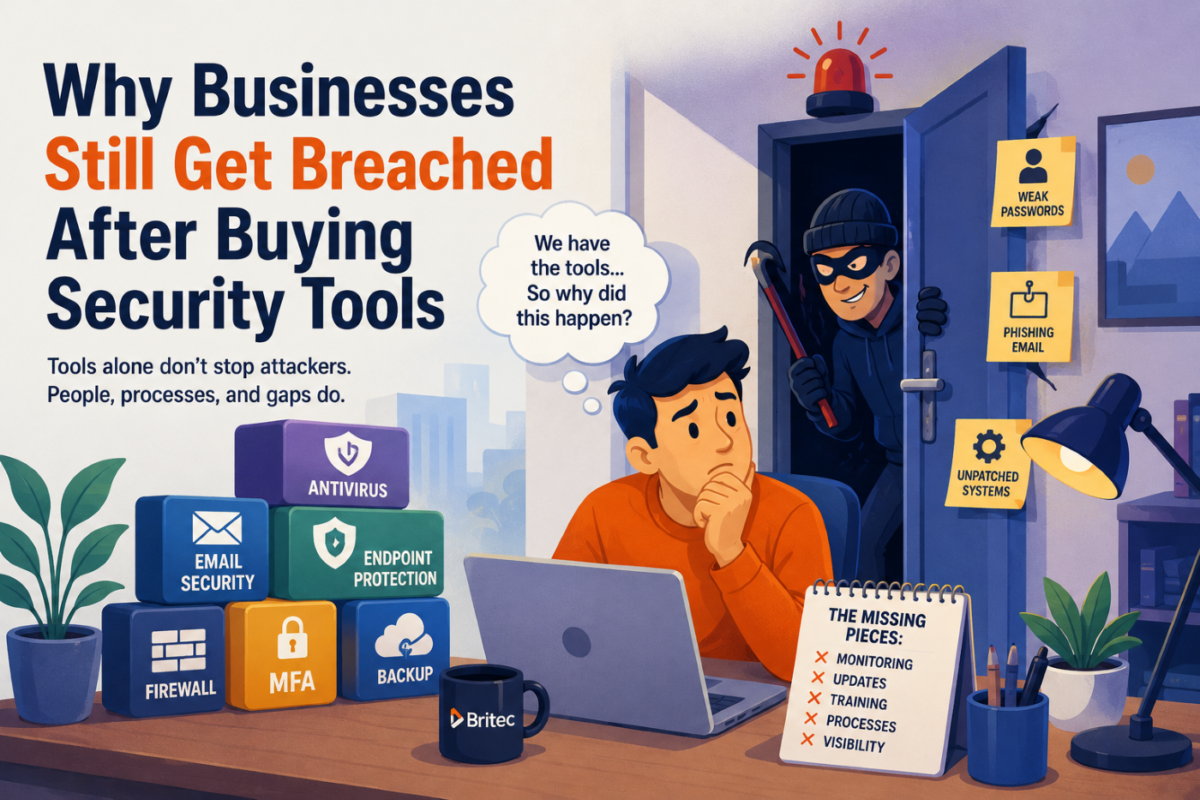
Why Businesses Still Get Breached After Buying Security Tools
Many businesses believe that once they invest in cybersecurity software, they’re protected.
They purchase antivirus, endpoint protection, email filtering, backups, and multi-factor authentication expecting those tools to stop attacks before they become serious problems.
The reality is more complicated.
Cybersecurity tools are important, but tools alone don’t create security. Without proper management, monitoring, strategy, and user awareness, even well-equipped businesses can still experience breaches, downtime, and ransomware incidents.
By the Numbers
- Human error contributes to nearly 70% of cybersecurity incidents
- More than 60% of breaches involve unpatched vulnerabilities
- Businesses now manage dozens of security and operational tools across daily operations
- Phishing and credential theft remain two of the most common attack methods worldwide
- Many ransomware attacks succeed because of operational gaps, not missing software
The Problem Isn’t Always Missing Tools
In many cases, businesses already have security products in place.
The issue is that:
- systems aren’t configured properly,
- alerts aren’t being reviewed,
- software isn’t consistently updated,
- employees aren’t trained,
- or security policies aren’t being enforced consistently.
Over time, gaps begin to form between systems, users, and processes. Those gaps are often what attackers exploit.
Attackers Target Weaknesses in Operations
Modern cyberattacks don’t always rely on advanced hacking techniques.
Many breaches happen because of:
- weak passwords,
- stolen credentials,
- phishing emails,
- unpatched software,
- excessive user permissions,
- or unmanaged devices.
Even businesses with multiple security tools can remain vulnerable if those operational issues are left unresolved.
More Tools Doesn’t Always Mean Better Protection
One of the biggest misconceptions in cybersecurity is that adding more software automatically improves security.
Truthfully, too many disconnected tools can actually reduce visibility and create operational complexity.
Teams become overwhelmed with alerts. Systems stop communicating properly. Important warnings get missed. Security responsibilities become unclear.
Eventually, businesses end up with a security environment that looks strong on paper but struggles in real-world situations.
Cybersecurity Requires Ongoing Management
Effective cybersecurity is not a one-time purchase. It’s an ongoing process that requires:
- regular patching and updates,
- monitoring and response,
- employee awareness training,
- access control reviews,
- backup testing,
- and clear operational procedures.
Technology plays a major role, but people and processes matter just as much.
Security Should Support the Entire Business
Strong cybersecurity is about more than stopping threats. It’s about building an environment that allows businesses to operate confidently, recover quickly, and reduce unnecessary risk.
That requires strategy, visibility, and systems that work together effectively.
At Britec, we help businesses evaluate not only the tools they use, but how those tools fit into the larger operational and security picture. The goal isn’t simply adding more software. It’s building a practical, manageable security environment that supports long-term business operations.
FAQ
Why do businesses still get breached with security software?
Security tools reduce risk, but poor configuration, weak processes, and human error can still create vulnerabilities.
Are cybersecurity tools enough on their own?
No. Effective cybersecurity also requires monitoring, updates, training, and operational planning.
What are the most common causes of breaches?
Phishing, stolen credentials, unpatched systems, weak passwords, and inconsistent access controls.
Can too many security tools create problems?
Yes. Overlapping or disconnected tools can create alert fatigue, complexity, and reduced visibility.
What should businesses focus on besides software?
Employee awareness, patch management, access control, backup testing, and ongoing monitoring.