
Why ERP Matters More Than Ever: The Foundation of Smarter Business Operations
As businesses grow, so does complexity.
What once worked with accounting software, spreadsheets, and disconnected applications can quickly become difficult to manage. Teams spend more time entering data, searching for information, and fixing mistakes than moving the business forward.
That’s where Enterprise Resource Planning (ERP) software comes in.
An ERP system brings your core business operations together into one connected platform, giving you better visibility, improved efficiency, and the information needed to make confident decisions.
If you’re already experiencing these challenges, you may find our guide on 7 Signs You’ve Outgrown QuickBooks helpful in determining whether it’s time to move beyond traditional accounting software.
By the Numbers
Some interesting ERP statistics to include:
- 71% of businesses want to use ERP data for predictive analytics or to forecast what will happen.
- 70% of companies believe that decisions are delayed if ERP data is unavailable.
- 63% of businesses want to use ERP data for descriptive analytics or to understand what happened.
- Only 1% of companies believe that there are no negative ramifications if ERP data is unavailable.
What Is an ERP System?
ERP stands for Enterprise Resource Planning.
Think of it as the central hub for your business.
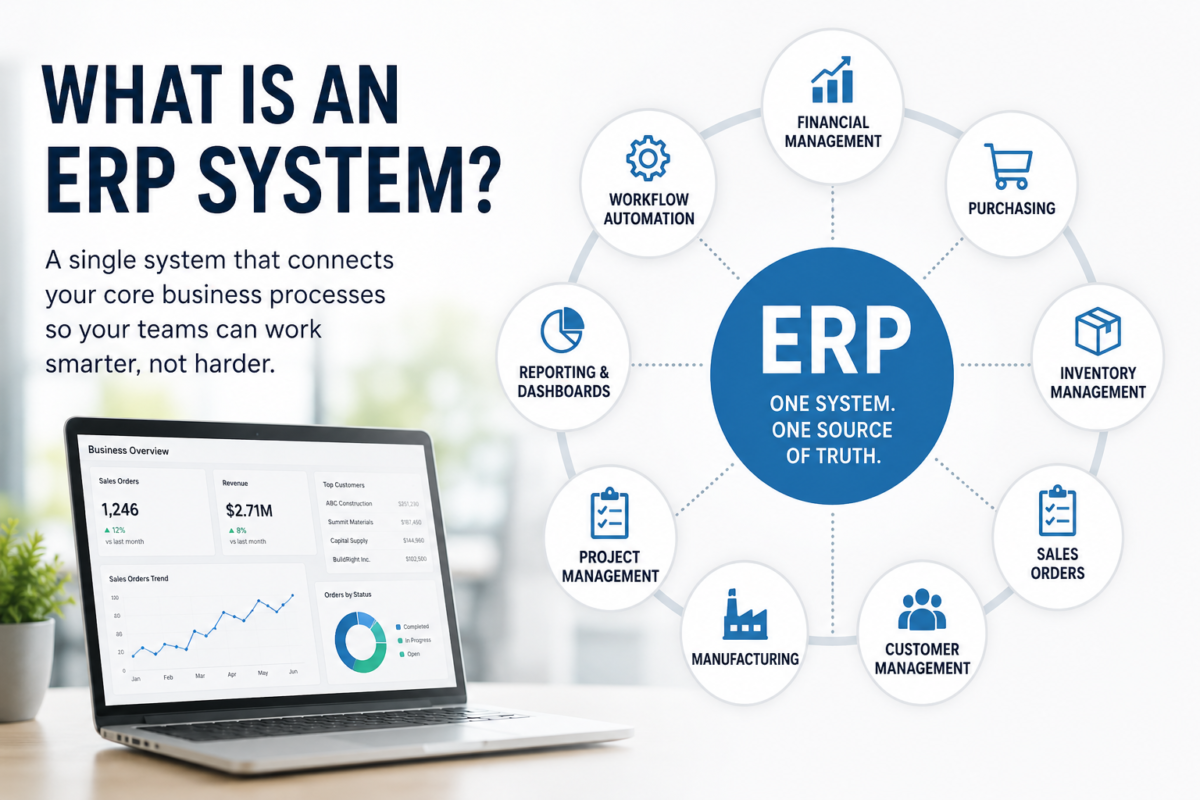
Instead of finance, inventory, purchasing, sales, customer information, production, and reporting living in separate applications, an ERP connects everything into a single system.
When information is entered once, it’s available everywhere it needs to be—reducing duplicate work, improving accuracy, and giving everyone access to the same real-time information.
What Does an ERP System Do?
Modern ERP software typically manages:
- Financial Management
- Purchasing
- Inventory Management
- Sales Orders
- Customer Management (CRM)
- Project Management
- Manufacturing
- Reporting & Dashboards
- Business Intelligence
- Workflow Automation
Instead of switching between five or six different programs, your team works from one connected platform.
Signs Your Business May Need an ERP
You don’t need to be a multinational corporation to benefit from ERP software.
Many growing businesses start looking at ERP when they notice things like:
- Too many spreadsheets
- Duplicate data entry
- Manual reporting
- Departments using different systems
- Inventory inaccuracies
- Slow month-end reporting
- Limited visibility into operations
- You’ve outgrown QuickBooks or other accounting software
If several of these sound familiar, it may be time to evaluate whether your current systems are holding your business back.
Benefits of ERP Software
The biggest advantage isn’t just technology.
It’s having better control over your business.
An ERP system can help businesses:
- Improve productivity
- Automate repetitive tasks
- Reduce manual errors
- Improve inventory accuracy
- Speed up financial reporting
- Make faster decisions with real-time data
- Support future growth without adding unnecessary complexity
Who Should Consider ERP?
ERP isn’t just for enterprise organizations anymore.
Today’s cloud ERP solutions are designed for growing businesses across industries, including:
- Construction
- Distribution
- Manufacturing
- Professional Services
- Retail & eCommerce
- Wholesale
If your business has outgrown disconnected software or manual processes, ERP may be the next logical step.
Choosing the Right ERP
Not every ERP platform is the same.
When evaluating options, consider:
- Cloud vs. on-premise
- Ease of use
- Industry-specific functionality
- Integration capabilities
- Reporting and dashboards
- Scalability
- Vendor support and implementation experience
Choosing the right implementation partner is just as important as choosing the software itself. Cloud ERP solutions such as Acumatica Cloud ERP provide businesses with flexibility, scalability, and real-time access to information from anywhere.
Final Thoughts
An ERP system isn’t simply accounting software with more features—it’s a platform designed to connect your entire business.
For organizations looking to improve efficiency, gain better visibility, and support long-term growth, ERP can become one of the most valuable investments they make.
Whether you’re just beginning to explore ERP or are comparing solutions, understanding what ERP does is the first step toward making an informed decision.
Ready to Learn More?
If you’re wondering whether ERP is the right fit for your business, the team at Britec can help you evaluate your current processes, identify opportunities for improvement, and determine the best path forward.
Book a Discovery Call with a Britec ERP Expert.
SEO FAQ
What does ERP stand for?
ERP stands for Enterprise Resource Planning. It is software that integrates core business functions into one centralized system.
What is the difference between ERP and accounting software?
Accounting software focuses primarily on financial management, while ERP includes finance along with inventory, purchasing, sales, operations, reporting, customer management, and more.
Who needs an ERP system?
Businesses experiencing growth, managing multiple departments, or relying on spreadsheets and disconnected systems often benefit from ERP software.
Is ERP only for large businesses?
No. Modern cloud ERP platforms are designed for small and mid-sized businesses as well as larger enterprises.
How do I know if my business has outgrown QuickBooks?
If you’re managing multiple spreadsheets, entering the same information more than once, or struggling with reporting and visibility, it may be time to evaluate an ERP solution.