
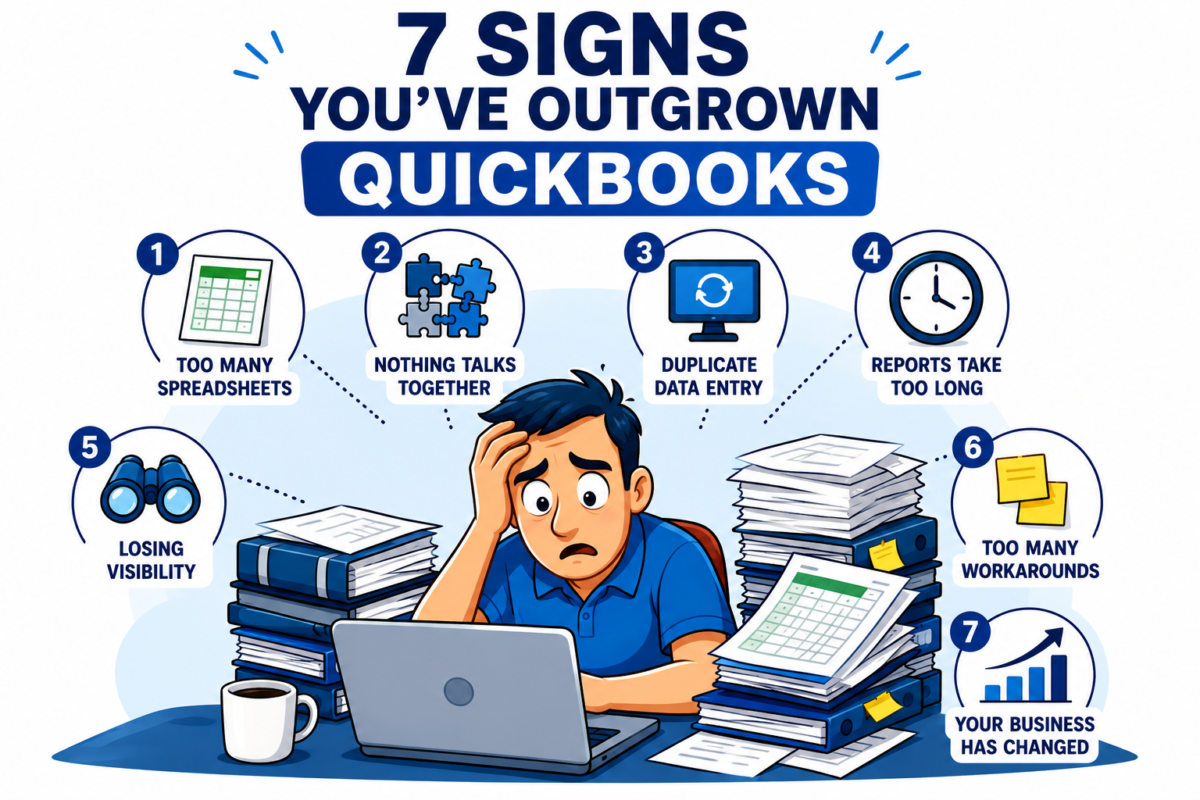
7 Signs You’ve Outgrown QuickBooks
QuickBooks has helped millions of businesses get off the ground. But what happens when the software that helped you grow starts slowing you down?
Introduction
For many businesses, QuickBooks is the perfect place to start.
It’s affordable, easy to use, and does exactly what growing companies need in the early years. But as businesses expand, hire more employees, manage more projects, or open additional locations, the cracks often begin to show.
If your finance team spends as much time working around QuickBooks as they do working in it, it may not be a people problem—it may be a sign your business has simply outgrown its accounting software.
Outgrowing QuickBooks isn’t a failure. In fact, it’s usually a sign your business is growing successfully.
The question is: How do you know when you’ve reached that point?
Does This Sound Familiar?
Growing businesses often experience the same challenges before moving to an ERP system:
- Finance teams spend a significant portion of their time collecting and validating data instead of analyzing it.
- Many growing companies rely on multiple spreadsheets alongside their accounting software to manage daily operations.
- Businesses using disconnected systems often experience duplicate data entry, reporting delays, and increased operational errors.
- Cloud ERP adoption continues to grow as organizations look for better visibility, automation, and scalability.
If any of those sound familiar, keep reading.
1. Your Spreadsheet Count Keeps Growing
It usually starts with just one.
A spreadsheet to track inventory.
Another for job costing.
One for purchase orders.
One for project budgets.
Before long, half the business is running in Excel while QuickBooks handles only the accounting.
☕ Britec Reality Check
If someone has to email you a spreadsheet before you can answer a customer’s question, your systems probably aren’t working together.
2. Nothing Talks to Anything Else
Your CRM doesn’t update accounting.
Inventory lives somewhere else.
Payroll uses another system.
Project management has its own software.
Every department has found its own solution, leaving your team to manually move information from one system to another.
That’s not automation.
That’s extra work.
3. You’re Entering the Same Information Twice
Sound familiar?
Sales enters customer information.
Accounting enters it again.
Operations enters it somewhere else.
Every duplicate entry wastes time and creates another opportunity for mistakes.
Growing businesses shouldn’t need to re-enter information just to keep systems up to date.
4. Reporting Takes Too Long
Your CFO asks a simple question.
“What’s our profit on this project?”
The answer should take minutes.
Instead, someone exports reports, combines spreadsheets, checks formulas, and hopes everything matches before the meeting.
Good decisions depend on good information.
If reporting takes days instead of minutes, your business loses valuable time.
5. You’re Losing Visibility as You Grow
Growth should improve visibility—not reduce it.
As construction projects become larger, manufacturing becomes more complex, or inventory expands, it becomes harder to answer questions like:
- Which jobs are most profitable?
- What’s our current inventory value?
- Where are we overspending?
- Which customers generate the highest margins?
If finding answers requires multiple reports and several spreadsheets, you’ve likely outgrown your current system.
6. Your Team Has Created Too Many Workarounds
One of the biggest warning signs isn’t found inside QuickBooks.
It’s everything built around it.
Sticky notes.
Manual checklists.
Shared spreadsheets.
Email reminders.
Processes that rely on “Karen knows how to do it.”
Workarounds are often a sign that software no longer matches the way your business operates.
7. Your Business Has Changed—Your Software Hasn’t
Think back to when you first implemented QuickBooks.
How many employees did you have?
How many customers?
How many projects?
How many locations?
Now compare that to today.
If your business has doubled in size but you’re still relying on the same tools and manual processes, it may be time to ask whether your accounting software is still supporting your growth.
Isn’t ERP Expensive?
This is one of the biggest misconceptions we hear.
Years ago, ERP systems often required significant upfront investments in servers, software, and infrastructure.
Today’s cloud ERP platforms work differently.
Many are subscription-based, allowing businesses to scale as they grow without the large capital investments traditionally associated with ERP. More importantly, they can help reduce manual work, improve visibility, and eliminate many of the inefficiencies that growing businesses experience.
The real question isn’t just “What does ERP cost?”
It’s also “What is our current system costing us in time, productivity, and missed opportunities?”
Can You Move from QuickBooks Without Starting Over?
Absolutely.
A properly planned ERP implementation can migrate key business information such as customers, vendors, inventory, financial data, and open transactions.
The goal isn’t to erase your history—it’s to build on it with systems designed to support your next stage of growth.
Working with an experienced implementation partner helps ensure the transition is structured, organized, and minimizes disruption to your business.
What Comes Next?
QuickBooks has helped countless businesses grow, and for many organizations, it’s still the right solution.
But if your team is relying on spreadsheets, struggling with disconnected systems, and spending too much time moving data instead of using it, your business may be ready for the next step.
That’s where a modern cloud ERP platform like Acumatica can make a real difference. By bringing accounting, operations, inventory, projects, reporting, and customer information together in one connected system, businesses gain greater visibility, improved efficiency, and the confidence to keep growing.
At Britec, we’ve spent more than 35 years helping Canadian businesses improve the way they use technology. Whether you’re in construction, manufacturing, or another growing industry, we can help you determine whether it’s time to move beyond accounting software and into a system built for growth.
Ready to Find Out if You’ve Outgrown QuickBooks?
If you’re wondering whether your current systems are holding your business back, let’s have a conversation.
Book a discovery call with Britec and we’ll help you assess where you are today, identify opportunities for improvement, and determine whether a modern ERP solution is the right next step.