
When Accounting Software Is No Longer Enough
Accounting software can be an excellent starting point. It helps a company record transactions, manage invoices, track expenses, and produce financial statements. However, as sales, inventory, projects, purchasing, and reporting become more complex, it may no longer provide the complete view a growing business needs.
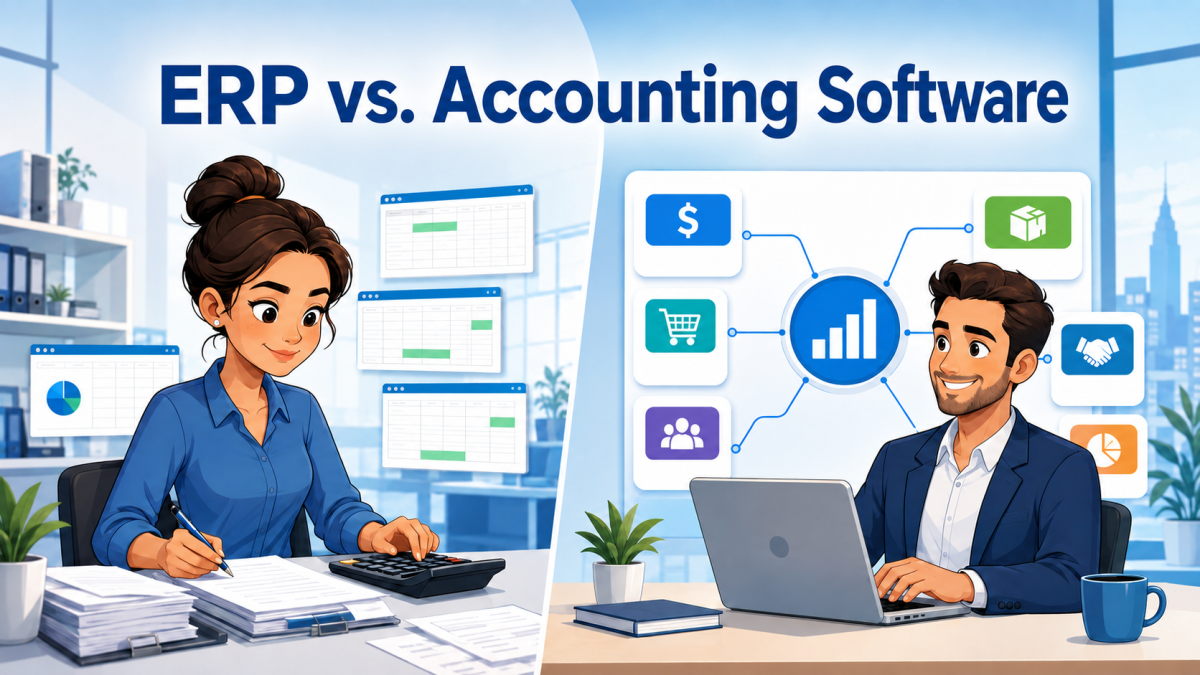
The simplest difference is this: accounting software manages financial activity, while Enterprise Resource Planning (ERP) software connects financial management with the rest of the business.
What Is Accounting Software?
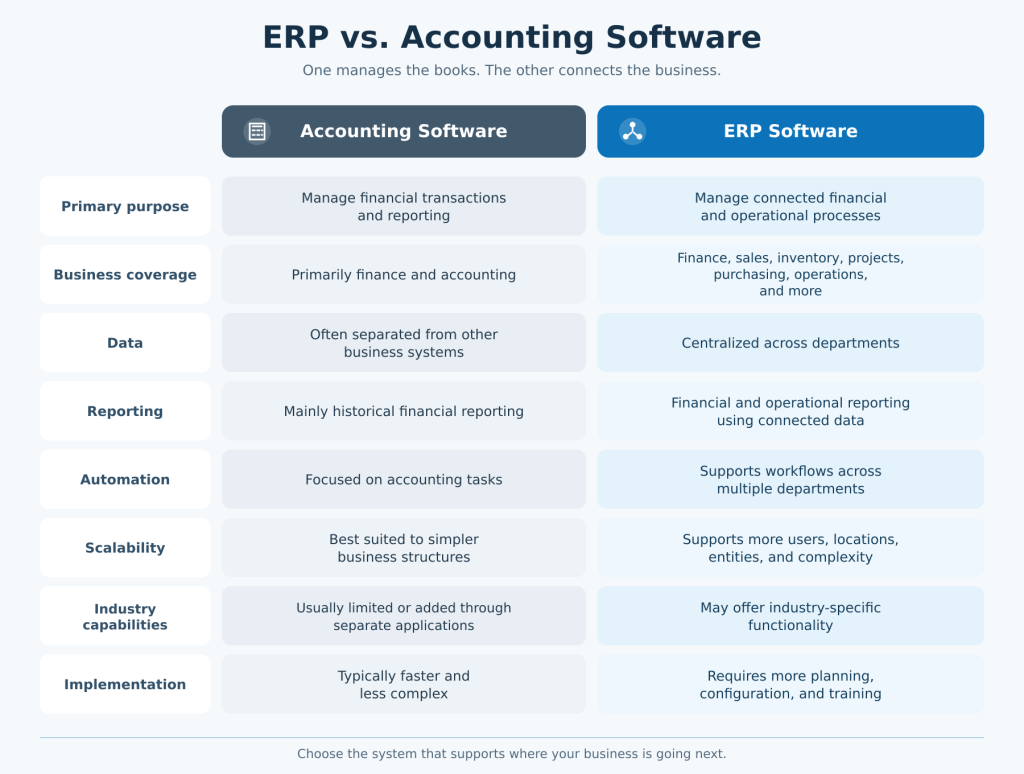
Accounting software is designed primarily to manage financial records and processes, including the general ledger, invoicing, accounts payable and receivable, expenses, bank reconciliation, and financial reporting.
For businesses with straightforward operations, these capabilities may be enough. Limitations usually appear when finance uses the accounting system while sales, inventory, projects, and purchasing depend on separate applications or spreadsheets.
What Is ERP Software?
ERP software includes financial management while connecting it with inventory, purchasing, sales, CRM, projects, construction, distribution, manufacturing, field service, and reporting.
Instead of moving information between separate systems, departments work from shared data. When an order is entered, for example, the same transaction can update inventory, revenue, purchasing requirements, and financial reports. Accounting remains essential—the difference is that it is connected to the operations producing the financial results.
Why the Difference Matters as a Business Grows
Growth creates more transactions, employees, customers, locations, approvals, and reporting requirements. The systems supporting the business must manage that complexity without creating more manual work.
A 2025 UK government study found that 91% of SMEs surveyed online said digital technology had positively affected their business, while 40% said it saved time. The findings cover technology broadly, but they demonstrate the value of selecting tools that fit how a business operates. (UK Department for Business and Trade)
UK Office for National Statistics analysis also found that combinations of ERP, CRM, and supply-chain technologies were associated with a productivity premium of approximately 25%. This is an association—not a guarantee that software alone creates productivity—but it shows the potential value of connected systems. (Office for National Statistics)
How ERP Supports Scalability and Growth
1. Better Visibility
Accounting software shows what has happened financially. ERP connects financial results with current sales, inventory, project, purchasing, and operational information. Leaders spend less time combining reports and gain a clearer view of performance.
2. Fewer Disconnected Systems
Growing companies often add an inventory application, CRM, project tool, or spreadsheet each time a new need appears. ERP connects key processes and reduces the duplicate entry and reconciliation created by separate systems.
3. Processes That Handle More Volume
Manual approvals, order processing, inventory updates, billing, and reporting become harder to sustain as volumes increase. ERP workflows help a company process more activity without increasing administrative work at the same rate.
4. Support for Greater Complexity
ERP can support additional locations, entities, product lines, currencies, and industry requirements. A construction company may need project accounting and change-order management, while a distributor may need inventory, replenishment, purchasing, and order-management capabilities. Accounting software records the result; ERP helps manage the activities leading to it.
When Is Accounting Software Still the Right Choice?
Not every business needs ERP.
Accounting software may remain the right fit when:
- Financial management is the company’s main software requirement
- Inventory, projects, and operations are relatively simple
- Reporting needs are straightforward
- Current processes are still efficient and reliable
Moving to ERP too early can add unnecessary cost and complexity. The decision should be based on business requirements—not simply company age, employee count, or revenue.
When Should a Business Consider ERP?
It may be time to evaluate ERP when:
- Teams repeatedly enter the same information into different systems
- Reports take too long to prepare or reconcile
- Spreadsheets have become essential to daily operations
- Inventory, orders, projects, and financial data do not match
- The business is adding locations, entities, or product lines
- Managers lack timely visibility into operational performance
- Manual processes are slowing growth or increasing errors
These signs do not automatically mean a business must replace its accounting software immediately. They do indicate that the cost of maintaining disconnected systems should be compared with the value of a connected ERP platform.
Where Acumatica Fits
Acumatica Cloud ERP connects financial management with capabilities such as inventory, order management, CRM, project accounting, construction, distribution, field service, and reporting. Businesses can begin with the functionality they need and expand as their requirements change.
Acumatica also uses resource-based pricing rather than charging a separate licence fee for every user. The right ERP should fit the company’s current processes, industry, integrations, reporting requirements, and plans for growth.
Build a System That Supports Growth
Accounting software remains a strong financial tool. ERP becomes valuable when finance and operations need to work together and disconnected systems are making growth harder to manage.
Britec helps growing businesses assess their requirements, compare ERP options, and determine whether Acumatica is the right fit. Talk to an Expert to start planning a system that can support where your business is going next.
Frequently Asked Questions
Is ERP the same as accounting software?
No. Accounting software focuses primarily on financial transactions and reporting. ERP includes financial management while also connecting areas such as inventory, sales, purchasing, projects, CRM, and operations.
Is ERP only for large businesses?
No. Modern cloud ERP systems can support small and midsized businesses as well as larger organizations. ERP is most useful when operational complexity—not company size alone—has outgrown simpler tools.
When should a business move from accounting software to ERP?
A business should consider ERP when disconnected systems, duplicate entry, slow reporting, limited visibility, or operational complexity begin interfering with efficiency and growth.